Turn sensory guesswork into a score you can repeat every follow-up.
Score it in minutes. Get instant graphs. Make the next step obvious, without adding more admin.
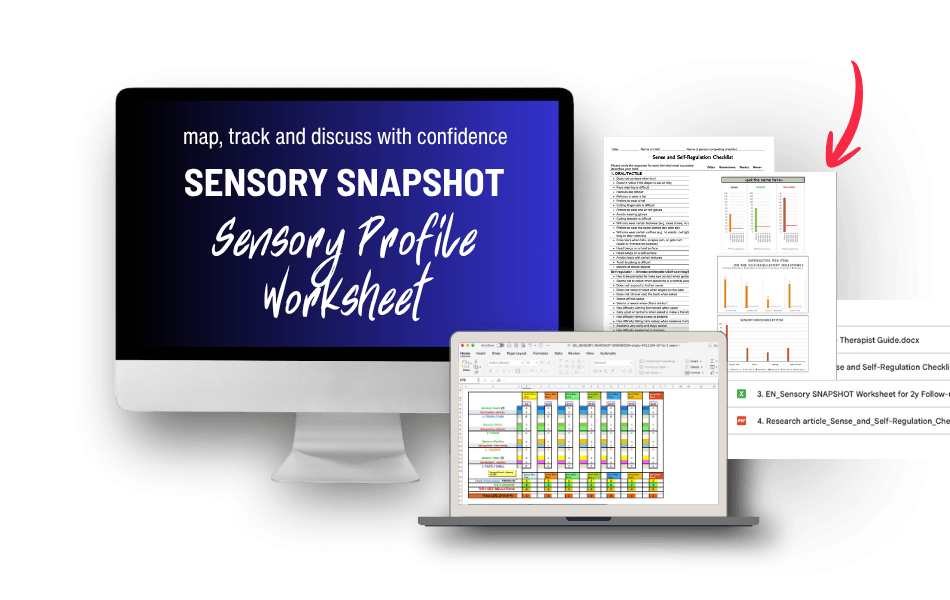
Therapist-only tool. Based on the Sense and Self-Regulation Checklist (SSRC), used in research, with a repeatable scoring method.
A concise sensory + self-regulation checklist (SSRC)
with automated scoring and graphs,
so you can baseline, track and show progress clearly.
Get the one-page dashboard system to show progress clearly - without waiting months to “feel” if therapy is working.
Includes the SSRC checklist + grading guide + automated excel dashboard (scores + graphs) + scripts.
Get a clean baseline in one single session (sensory + self-regulation in one concise checklist).
Repeat the same score at every follow-up so progress is visible, not “vibes”.
Generate instant one-page graphs you can use for parent debriefs, team alignment, and case reviews.
Make the next step obvious by linking sensory load to self-regulation capacity, so you stop working the wrong priority.
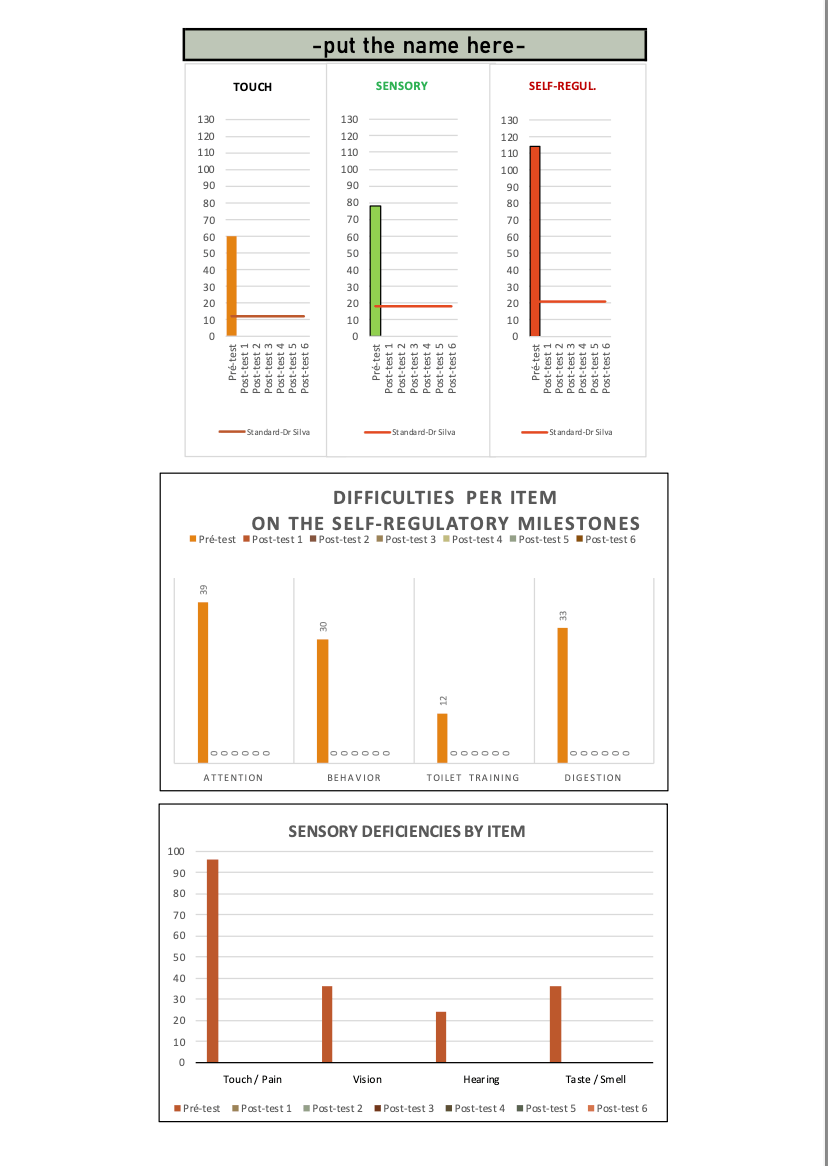
You get a total score, clear graphs and item-level meaning, so you can explain what is happening neurologically and what to prioritise next.

This is for professionals who want repeatable sensory + self-regulation tracking without more admin.
WHO IT'S FOR
Therapists and professional coaches working with children or youngsters where sensory sensitivity is suspected.
Clinicians in any setting (private practice, schools, clinics, multidisciplinary teams).
Professionals working with verbal and non-verbal clients, across all ages and broader neurodivergence.
Anyone who is tired of: firefighting, too many variables and not being able to prove progress.
WHO IT'S NOT FOR
Anyone looking for a full diagnostic sensory assessment or a “standardised testing battery”. This is a fast, practical, repeatable screening + follow-up score built for decision-making, not for labelling.
Anyone who needs a checklist that clients fill out alone without professional interpretation (this is designed as therapist-only use).
WHY THERAPIST ONLY?
The SSRC is designed to be completed consistently across time (same rater each time) so scores stay comparable.
You are the one who can keep that consistency and translate the score into next steps.
I was doing everything a “good therapist” is supposed to do.
I supported regulation in the moment.
I adapted.
I problem-solved.
But week after week, the same thing kept happening: firefighting.
Too many variables.
No clear driver.
And no clean way to prove progress to parents or a team.
Then I realised the problem was not a lack of strategy.
The problem was measurement.
Most tools either create a sensory profile or talk about self-regulation.
They do not link the two in a practical way, even though in real life they move together.
So we keep chasing “emotional regulation” while sensory impairment stays invisible.
That is why I started using the sense and self-regulation checklist (SSRC) as my baseline tool.
It combines sensory challenges with self-regulation challenges in one concise checklist, with a simple scoring method you can repeat over time.
And once you can measure it, the next step becomes obvious.

Now I can show progress clearly, with a score and a one-page graph, instead of hoping everyone “feels” that therapy is working.
And inside the sensory snapshot, I give you the exact setup: the checklist, the grading guide and the automated dashboard that turns your follow-ups into visible change.

Research-backed foundation
The sensory snapshot is built on the sense and self-regulation checklist (SSRC) that has been used in Dr Silva’s research (paper included in the folder).
Clinical usability
(instant graphs + meaning)
You get an automated dashboard that generates one-page graphs and gives the neurological meaning of each item, so results are easy to explain in debriefs and team reviews.
Fast to score. Easy to repeat. Easy to explain.
Repeatable scoring, not “vibes”
This is not a “describe your child” sensory profile.
It is a scored checklist + grading method so you can run the same measure at baseline and follow-ups.
It is actually easy to complete
In practice, therapists report the same thing: parents can answer quickly because the questions match lived experience and are concise (no overthinking, no long forms).
Here is what’s included
Sensory snapshot toolkit (instant download folder)
A therapist-only pack you can use immediately: the sense and self-regulation checklist + simple scoring, so you can turn “sensory guesswork” into a repeatable baseline and follow-up score.
Sense + self-regulation checklist (research-based)
A concise, parent-friendly checklist that links sensory processing and self-regulation in one tool (instead of a sensory profile that lives in a separate universe). It includes clear instructions for consistent re-testing over time.
Automated dashboard worksheet (graphs + meaning)
Drop the scores into the worksheet and get a one-page view you can use in reports, team reviews and debriefs: score, dashboard, graphs and interpretation prompts (so you are not “explaining vibes” to parents or colleagues).
Clinical communication mini-pack (so it actually gets used)
Short scripts and templates to make implementation frictionless:
- Parent invite script.
- Case review note template.
- 10-minute debrief script.
- Plus the “real change tracker” bonus so you can compare expected progress against what you are currently getting and decide if you need to switch priorities (sensory-first) for this client.
Why hasn’t anyone told us this?
They say: “Work on regulation first.”
They say: “If the child is calmer, you’re making progress.”
They say: “Sensory is just one piece of the puzzle.”
Here is the problem.
If sensory impairment is driving the load, “regulation first” becomes a loop.
You get short relief in the moment.
Then the child crashes again.
And you are back to firefighting.
The mistake is not your effort.
The mistake is that most systems separate sensory issues from self-regulation as if they are different problems.
So you track behaviour.
Or you track emotions.
Or you track goals.
But you do not track the correlation that actually predicts daily capacity.
New truth: sensory load and self-regulation capacity move together and you need a tool that measures both in one repeatable score.
That is exactly what the sensory snapshot gives you:
baseline → follow-up → one-page graphs → clear next step.
Because when you can measure the driver, you stop guessing.
And when you stop guessing, your plan becomes simpler, not bigger.
Start tracking real change today
Turn sensory guesswork into a repeatable follow-up score, with instant graphs and clear next steps.
SENSORY SNAPSHOT
€ 27
INSTANT ACCESS
Use it with one current client in the next 24 hours.
You get instant access to a google drive folder (excel + docs + pdf).
Licence: single therapist licence
What you get immediately
Sense and self-regulation checklist (SSRC) + grading guide (repeatable scoring).
Automated excel dashboard that generates one-page graphs + interpretation prompts.
Bonus 1: Clinical communication mini-pack: parent invite script, case review note template, 10-minute debrief script.
Bonus 2: Real change tracker for autism therapy (compare expected progress with what you are currently seeing).
_FAQ
No. This is a fast screening + follow-up measurement tool to guide priorities and track change over time. It supports clinical decision-making. It is not a diagnostic label.
No. And that is the point. Many standard tools build a sensory profile but do not link sensory load to self-regulation capacity in a practical, repeatable way. This one does.
You can still use the sensory snapshot. It is a measurement system, not a technique. It helps you track progress no matter what approach you use.
It still applies. The checklist targets lived-experience patterns that show up across verbal and non-verbal clients, and you score it consistently as the therapist.
In practice, yes. The questions are concise and map onto lived experience, so parents usually know the answers quickly. You can also complete it in session with them.
Notes are not repeatable measurement. This gives you:
A baseline score you can repeat at every follow-up.
One-page graphs you can show and discuss.
A clear way to decide whether your current plan is getting the results that should be possible.
It reduces admin. When you stop guessing, you stop rewriting plans, re-explaining the same situation and managing confusion. Score in minutes, get the graphs automatically.
Yes, but the licence is single therapist. The cleanest use is: one clinician scores it consistently across time, then shares the one-page graphs in team reviews.
Pick one current client. Run the checklist once. Score it. Look at the graphs. Compare with the real change tracker. Decide whether your priorities need to shift to sensory-first for better outcomes.
Stop guessing at your next follow-up
If you have a child on your caseload where progress feels vague, this is your clean reset.
One baseline score.
One follow-up score.
One page that tells you what is changing and what is not.
You can start today with one current client.
Instant access. Single therapist licence. Use in your next session.
If you are in the middle of a plateau, do not wait for the next “review moment”.
Baseline it now, so you have a clean reference point next month.
Post-purchase path
Purchase.
Get instant access to the folder.
Run the checklist with one client.
Use the dashboard + debrief script to align parent/team.
Add the bump if you want food strategies (feeding the sensitive system, €33).
Take the upsell if you want crisis handling support (confidence care strategies, €67).